
For decades, video has captured the world in flat, two-dimensional frames. While traditional video transformed communication and entertainment, it still limits how deeply viewers can interact with what they see.
Today, a new medium is emerging that this experience entirely: volumetric video. Instead of recording scenes as flat images, volumetric video captures subjects in full three-dimensional space-allowing viewers to move around, explore perspectives, and experience content almost as if they were physically present.
At TeMetaTech, we see volumetric video as a major step toward immersive digital experiences across industries – from professional training to entertainment and live events.
What Is Volumetric Video?
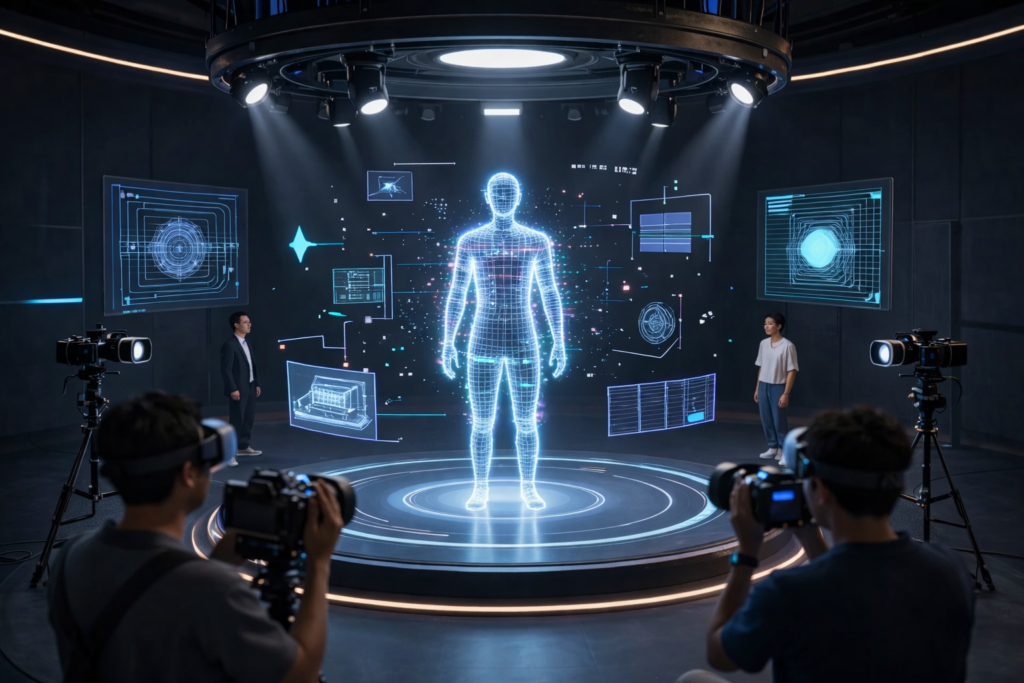
Volumetric video is a recording technique that captures the entire volume of a real-world subject – including depth, shape, and movement – rather than just a 2D image.
Using multiple cameras and sensors arranged around a subject, the system reconstructs a detailed 3D model in motion. The result is a dynamic, holographic representation that can be viewed from any angle.
Unlike traditional video, volumetric content is not limited to a fixed camera viewpoint. It enables interactive viewing in virtual or augmented environments.
How Volumetric Capture Works
The process involves several coordinated technologies:
Multi-Camera Capture
Dozens or even hundreds of synchronized cameras record a subject simultaneously from multiple angles.
Depth Sensing
Sensors measure distance and spatial structure, allowing accurate 3D reconstruction.
AI-Based Processing
Advanced algorithms stitch footage together, clean artifacts, and generate smooth volumetric models.
Real-Time Rendering
The final output can be streamed or integrated into VR/AR platforms for interactive viewing.
This pipeline transforms raw visual data into fully navigable 3Dexperiences.
Impact on Professional Training
Training environments benefit enormously from immersive realism.
Volumetric video enables:
· Realistic medical simulations
· Industrial safety training
· Equipment operation walkthroughs
· Emergency response practice
Learners can observe procedures from multiple angles, improving understanding and retention. Complex physical actions become easier to visualise and replicate.
Transforming Film and Entertainment
The entertainment industry is exploring volumetric storytelling to create new forms of cinematic expression.
Applications include:
· Interactive movie scenes
· Performances that viewers can explore spatially
· Digital doubles of actors
· Virtual stage production
Volumetric capture allows creators to break free from fixed camera perspectives, enabling more immersive storytelling.
Reinventing Live Events
Live experiences – concerts, sports, conferences – are becoming more accessible through volumetric streaming.
Audiences can:
· View performers from different angles
· Experience events as holographic projections
· Participate remotely in spatial environments
This expands accessibility while preserving the sense of presence that traditional broadcasts cannot match.
Benefits of Volumetric Video
· Immersive, interactive viewing
· Improved learning and training outcomes
· Enhanced storytelling possibilities
· Greater audience engagement
· Realistic digital representation
· New hybrid physical-digital experiences
Volumetric content bridges the gap between real-world interaction and digital media.
Challenges and Considerations
Despite its promise, volumetric video faces hurdles:
· High capture and processing costs
· Large data requirements
· Complex production workflows
· Real-time rendering limitations
· Hardware accessibility
As computing power, AI processing, and compression technologies improve, these barriers are gradually diminishing.
Conclusion
Volumetric video represents a new dimension of visual communication. By capturing subjects in full 3D space, it transforms how we learn, entertain, and connect – moving beyond passive viewing toward interactive presence.
From immersive training simulations to next-generation storytelling and live holographic events, volumetric technology is shaping the future of digital media.
At TeMetaTech, we believe volumetric video will play a key role in the evolution of spatial computing – creating richer, more human-centered digital experiences.
The future of video is not just watched – it explored.