
For decades, IT infrastructure has been managed through predefined rules, manual configurations, and reactive troubleshooting. When something failed, teams investigated logs, applied fixes, and hoped the same issue wouldn’t happen again.
Today, that model is changing.
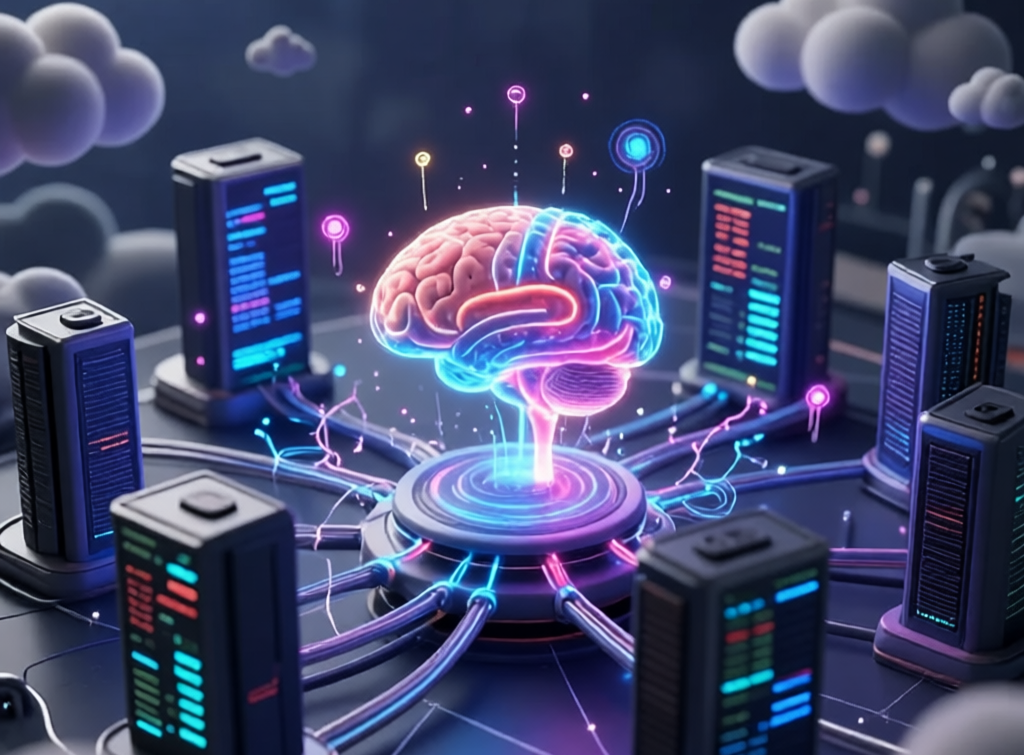
Modern digital systems are becoming too large, dynamic, and complex for static infrastructure management. This is giving rise to a new paradigm known as Infrastructure as Intelligence (IaI) – where infrastructure doesn’t just run workloads, but learns from its own behaviour and failures.
At TeMetaTech, we see IaI as a natural evolution of cloud-native and AI-driven operations – one that is redefining how resilient and scalable systems are built.
What Is Infrastructure as Intelligence (IaI)?
Infrastructure as Intelligence refers to infrastructure that uses machine learning and real-time analytics to manage itself.
Instead of relying only on predefined rules, IaI systems:
· Observe system behaviour continuously
· Detect anomalies and inefficiencies
· Learn from failures and performance issues
· Automatically optimise configurations
· Heal themselves when problems occur
In simple terms, the infrastructure becomes adaptive and self-improving.
How IaI Is Different from Traditional Infrastructure
Traditional infrastructure management is largely reactive:
· Alerts notify teams after failures occur
· Scaling decisions are pre-configured
· Recovery often requires human intervention
IaI introduces a proactive and intelligent layer.
| Traditional Infrastructure | Infrastructure as Intelligence |
| Static rules | Adaptive learning mode |
| Manual tuning | Automatic optimisation |
| Reactive incident handling | Predictive issue prevention |
| Human-led operations | Machine-led operations |
Instead of responding to problems, IaI aims to prevent them.
Core Capabilities of IaI Systems
1. Self-Monitoring
IaI systems continuously analyse metrics such as performance, latency, errors, and resource usage – far beyond simple threshold alerts.
2. Learning From Failures
Every Outage, slowdown, or anomaly becomes training data.
The system learns:
· What caused the issue
· How it was resolved
· How to avoid it in the future
Over time, the infrastructure becomes smarter and more resilient.
3. Self-Healing
When issues occur, IaI systems can:
· Restart services
· Rebalance workloads
· Roll back faulty deployments
· Reroute traffic automatically
All without waiting for human intervention.
4. Self-Optimisation
IaI continuously tunes itself by:
· Adjusting resource allocation
· Optimising scaling behaviour
· Reducing latency and cost
· Improving overall performance
5. Auto-Configuration
Based on usage patterns and demand, infrastructure settings are adjusted automatically – reducing misconfigurations and human error.
Why IaI Matters for Modern Enterprises
As organisations move toward cloud-native, microservices, and distributed systems, infrastructure complexity increases significantly.
IaI helps enterprises by:
· Reducing downtime and outages
· Lowering operational overhead
· Improving system reliability
· Enabling faster scaling
· Minimising human error
· Supporting 24/7 autonomous operations
For businesses, this translates into more stable platforms and lower operational risk.
Where Infrastructure as Intelligence Is Being Applied
· Cloud Platforms: Intelligent autoscaling, anomaly detection, and predictive maintenance.
· DevOps & Platform Engineering: Automated pipelines that adapt based on deployment outcomes.
· Microservices Architectures: Dynamic service routing and resilience management.
· Edge Computing: Self-managing systems in remote or disconnected environments.
· Enterprise IT Operations: reduced alert fatigue and faster incident resolution.
These use cases show how IaI is moving from concept to practical adoption.
Challenges to Consider
While powerful, IaI is not plug-and play:
· Requires high-quality observability data
· Needs careful model training and validation
· Must maintain transparency and control
· Requires strong governance and security policies
Most organisations adopt IaI incrementally, starting with monitoring and self-healing before moving toward full optimisation.
Conclusion
Infrastructure as Intelligence represents a fundamental shift in how systems are built and operated. By allowing infrastructure to learn from failures, adapt to changing conditions, and optimise itself continuously, IaI moves operations from manual control to intelligent autonomy.
Traditional infrastructure focused on stability through rules. IaI delivers resilience through learning.
At TeMetaTech, we believe Infra as Intelligence is a key step toward truly autonomous digital platforms – systems that don’t just recover from failure, but improve because of it.
The future of infrastructure isn’t just automated. It’s intelligent.