
Modern enterprises are under constant pressure to innovate faster, adapt to change, and deliver better digital experiences. However, many organisations still rely on monolithic systems – large, tightly integrated applications that are difficult to update, scale, or modify.
This rigidity slows down innovation and increases operational complexity.
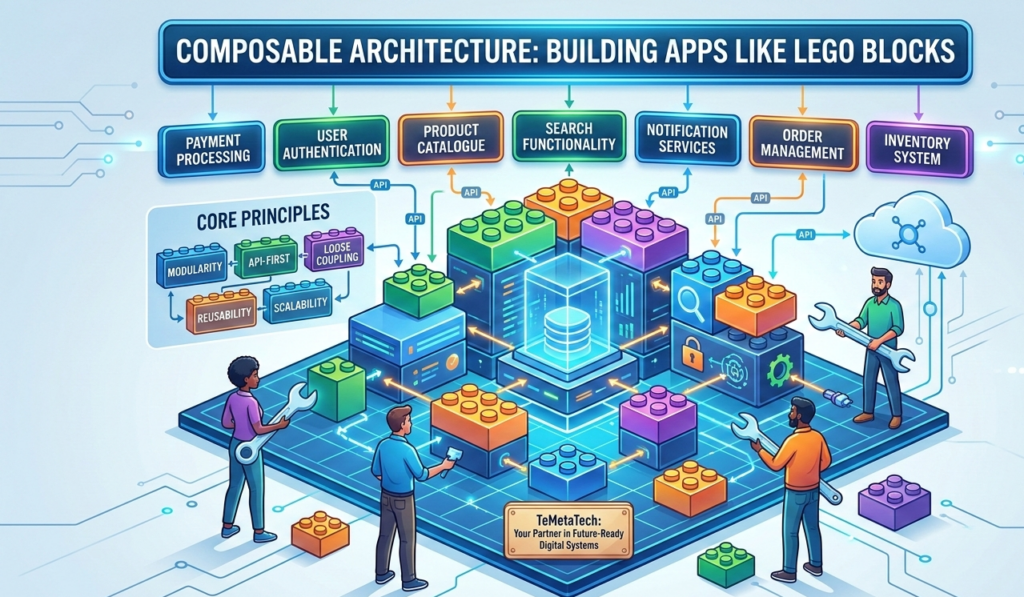
To overcome these limitations, businesses are adopting a new approach: Composable Architecture – a model where applications are built using modular, interchangeable components, much like LEGO blocks.
At TeMetaTech, we see composable architecture as a practical way to build flexible and future-ready digital systems.
What is composable Architecture?
Composable architecture is a design approach where applications are assembled from independent, reusable modules that can be combined, replaced, or updated without affecting the entire system.
Each module typically represents a specific business capability, such as:
- Payment processing
- User authentication
- Product catalogue
- Search functionality
- Notification services
These modules communicate through APIs and can be developed, deployed, and scaled independently.
Instead of building one large application, organisations create a system of connected components.
Why Traditional Monolithic Systems Fall Short
Monolithic applications bundle everything into a single codebase. While this approach may work initially, it creates challenges as systems grow:
- Difficult to update small features without redeploying the entire system
- Limited scalability across different components
- Slower development cycles
- Higher risk during changes or upgrades
- Reduced flexibility in adopting new technologies
Composable architecture addresses these issues by breaking systems into manageable pieces.
Core Principles of Composable Architecture
- Modularity
Applications are divided into smaller, self-contained components, each responsible for a specific function.
- API-First Design
Modules communicate through well-defined APIs, ensuring seamless integration.
- Loose Coupling
Components operate independently, reducing dependencies and improving resilience.
- Reusability
Modules can be reused across different applications and use cases.
- Scalability
Each component can scale based on demand, improving performance and cost efficiency.
How Composable Systems Work in Practice
In a composable enterprise system:
- The front end interacts with multiple backend services
- Each service handles a specific function
- APIs connect these services into a unified experience
- New features can be added by integrating new modules
For example, an e-commerce platform might use:
- A third-party payment service
- A custom recommendation engine
- A cloud-based search module
- A separate inventory system
All working together without being tightly bound.
Benefits for Enterprises
Faster Innovation
Teams can build and release features independently without affecting the entire system.
Flexibility
New technologies or tools can be integrated without redesigning the entire application
Improved Resilience
Failures in one module do not bring down the entire system.
Scalable Performance
Each component scales independently based on usage.
Cost Efficiency
Resources are allocated only where needed, reducing waste.
Composable architecture enables organisations to respond quickly to market changes.
Where Composable Architecture is Used
- E-commerce platforms (headless commerce systems)
- Banking and fintech applications
- Enterprise SaaS platforms
- Content management systems
- Digital experience platforms
It is especially useful in environments where flexibility and rapid change are critical.
Challenges to Consider
While powerful, composable architecture introduces new complexities:
- Managing multiple services and APIs
- Ensuring consistent data across modules
- Monitoring distributed systems
- Handling security across multiple endpoints
- Maintaining governance and standardisation
A strong architecture strategy and proper tooling are essential for success.
The Future of Enterprise Systems
As business become more digital and dynamic, rigid systems will no longer be sufficient. Composable architecture allows organisations to build systems that evolve continuously – adapting to new requirements without major disruptions.
Instead of building applications once and maintaining them, enterprises will assemble and refine systems as needed.
Conclusion
Composable Architecture represents a shift from rigid, monolithic systems to flexible, modular design. By building applications like LEGO blocks, organisations gain the ability to innovate faster, scale efficiently, and adapt to change with confidence.
At TeMetaTech, we believe composable systems are key to building modern digital platforms that are resilient, scalable, and future-ready.
The future of software is not built in one piece – it’s assembled, improved, and reassembled continuously.