
For decades, software has followed a predictable pattern: users give instructions, and applications respond. Whether it’s sending an email, generating a report, or managing workflows, traditional software depends heavily on explicit human unput.
But this model is beginning to change.
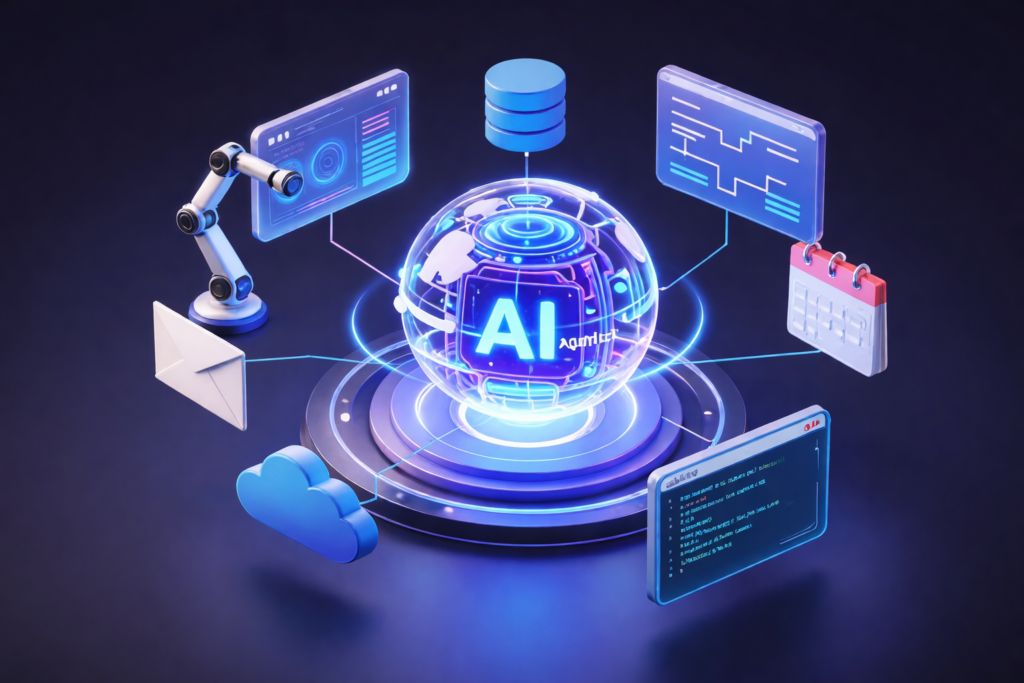
A new generation of systems – known as Agentic AI Systems – is redefining how software operates. These systems do not just respond to commands: they act independently, make decisions, and complete tasks with minimal human involvement.
At TeMetaTech, we see agentic AI as a major step toward more intelligent, self- directed digital systems.
What Are Agentic AI Systems?
Agentic AI systems are software programs designed to operate as autonomous agents. They can:
· Understand goals
· Plan actions
· Execute tasks
· Adapt based on feedback
· Interact with other systems
Instead of waiting for step-by-step instructions, these agents work toward outcomes.
For example, instead of asking software to:
· “Create a report”
· “Analyse data”
· “Send updates”
A user can simply define a goal like: “Prepare and share a weekly performance summary.”
The agent handles the rest – gathering data, analysing it, formatting report, and distributing it.
How Agentic AI Differs from Traditional Software
Traditional applications are:
· Task-driven
· Reactive
· Rule-based
· Dependent on user input
Agentic systems are:
· Goal-driven
· Proactive
· Adaptive
· Capable of decision-making
| Traditional Software | Agentic AI System |
| Executes commands | Pursues goals |
| Fixed workflows | Dynamic workflows |
| Requires constant input | Operates independently |
| Limited adaptability | Learns and improves |
This shift transforms software from a tool into an active participant in workflows.
Key Capabilities of Agentic AI
1. Goal Understanding
Agents interpret high-level objectives and break them into actionable steps.
2. Planning and Execution
They create workflows dynamically – deciding what to do, in what order, and using which tools.
3. Tool Integration
Agents can interact with APIs, databases, software systems, and external services to complete tasks.
4. Continuous Learning
They improve over time by learning from outcomes and feedback.
5. Multi-Agent Collaboration
Multiple agents can work together – dividing tasks, sharing information, and coordinating actions.
Where Agentic AI Is Being Used
Business Operations
Agents automate reporting, scheduling, and workflow coordination.
Customer Support
AI agents resolve queries, escalate issues, and manage interactions end-to-end.
Software Development
Agents assist in coding, testing, debugging, and deployment processes.
Sales and Marketing
Agents analyse customer data, generate campaigns, and personalise outreach.
IT and Infrastructure Management
Agents monitor systems, detect anomalies, and resolve issues proactively.
In each case, agentic AI reduces manual effort and increases efficiency.
Benefits for Enterprises
· Faster execution of complex tasks
· Reduced dependency on manual workflows
· Improved productivity across teams
· More consistent and accurate outcomes
· Ability to scale operations without increasing headcount.
Agentic AI enables organisations to move from task automation to outcome automation.
Challenges and Considerations
While promising, agentic AI introduces new challenges:
· Ensuring reliability and accuracy
· Defining clear boundaries and controls
· Managing unintended actions
· Maintaining transparency and accountability
· Integrating with existing systems
Human oversight remains essential, especially for critical decisions.
The Future of Software
As agentic systems evolve, the role of traditional applications will shift. Instead of interacting with multiple tools separately, users will rely on intelligent agents that coordinate everything behind the scenes.
Interfaces will become simpler, while underlying systems become more complex and capable.
Software will no longer be something we operate directly – it will become something that works on our behalf.
Conclusion
Agentic AI systems represent a major transformation in how software is designed and used. By enabling systems to act independently, make decisions, and complete tasks, organisations can achieve higher efficiency and flexibility.
At TeMetaTech, we believe agentic AI is a key step toward building intelligent digital ecosystems where software is not just responsive, but proactive and goal-oriented.
The future of software is not just interactive – it is autonomous.